
Leading and Learning in wash
Leading and Learning in wash

Rollins Magazine – Spring 2026
By Shelby Crosier
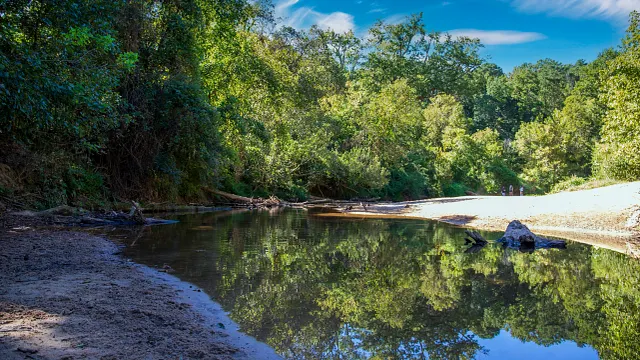
The day that the South Fork of Peachtree Creek turned orange, neighborhood families were concerned. The creek runs through many backyards and community spaces near Emory University. Kids and dogs splash in its shallow waters. What if this natural resource was not as safe as they thought?
The color change turned out to be from clay released when a water main was repaired upstream. Now the community wanted to know: What else could be lurking in our local creek?
That’s where Christine Moe, PhD, Eugene J. Gangarosa Professor of Safe Water and Sanitation, came in.
“I live in the neighborhood, and I was talking with my neighbors, mentioning how I sometimes collected water samples from the creek in my backyard for a hands-on water testing assignment for a class that I taught,” says Moe. “I told them that it’s shocking sometimes how contaminated the water is in that creek.”
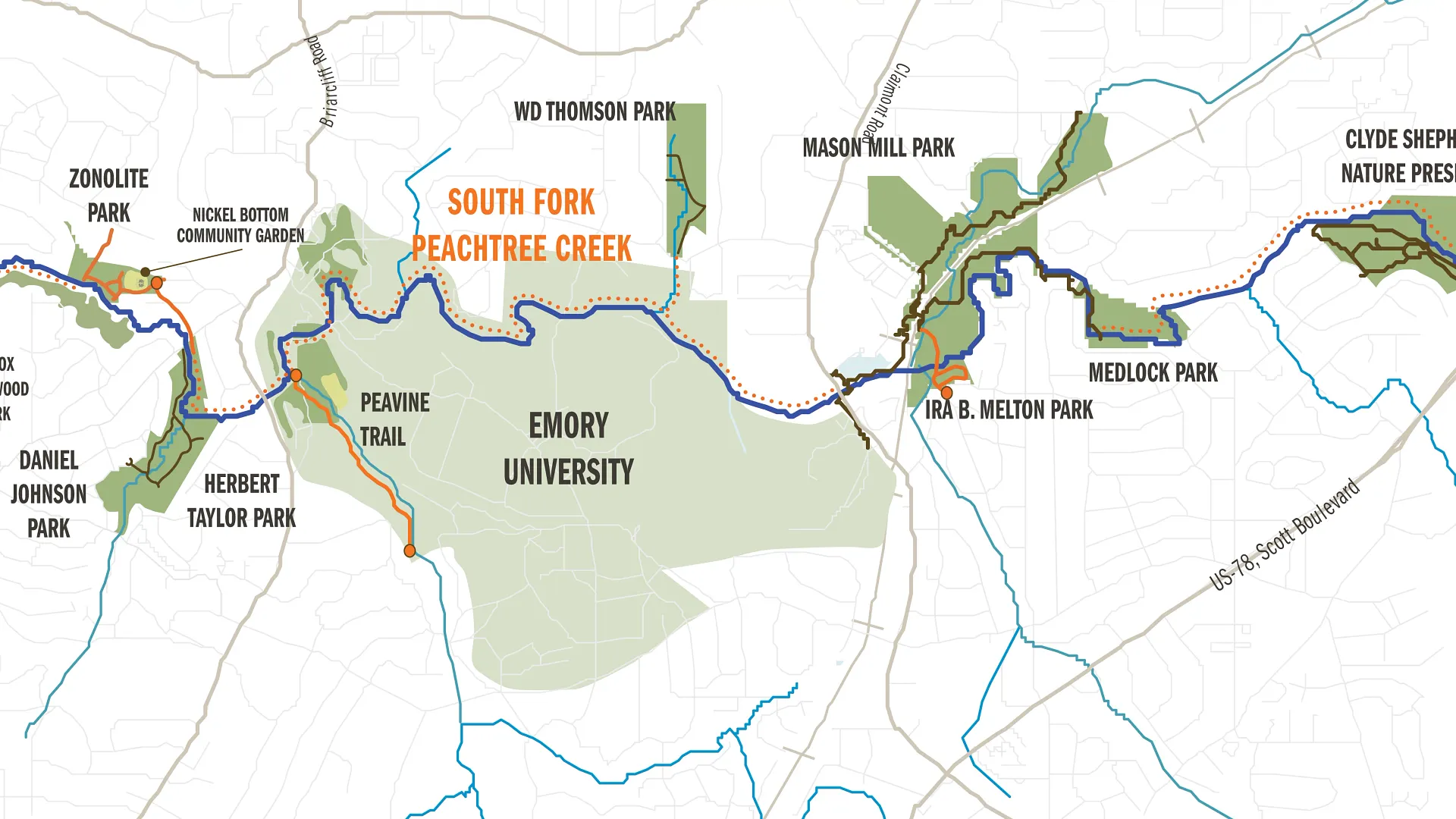
This map depicts where the South Fork of Peachtree Creek flows near Emory University and the surrounding neighborhoods. Provided by South Fork Conservancy.
One of Moe’s neighbors was involved in South Fork Conservancy, a local nonprofit dedicated to restoring the banks of the waterway which flows from Tucker to Druid Hills, where it runs along the western edge of Emory University’s campus.
“This neighbor came up with the idea to start a monitoring program and see what type of information we could gather about the creek,” said Moe.
The project began in January 2025. Moe’s lab group worked with neighborhood volunteers to collect water samples every two weeks from four sites along Peavine and Lullwater Creeks, offshoots of the South Fork of Peachtree Creek, including one site right behind a sub sandwich shop in Emory Village. The volunteers brought their samples to Rollins, where they left them in an ice box for a lab member to collect.
Emmanual Kyereh, PhD, a second-year Master of Public Health student, took over from there, bringing the samples up to the lab where he measured their pH and turbidity (cloudiness, which can be caused by sediment in the water), and tested for E. coli, an indicator of fecal contamination.
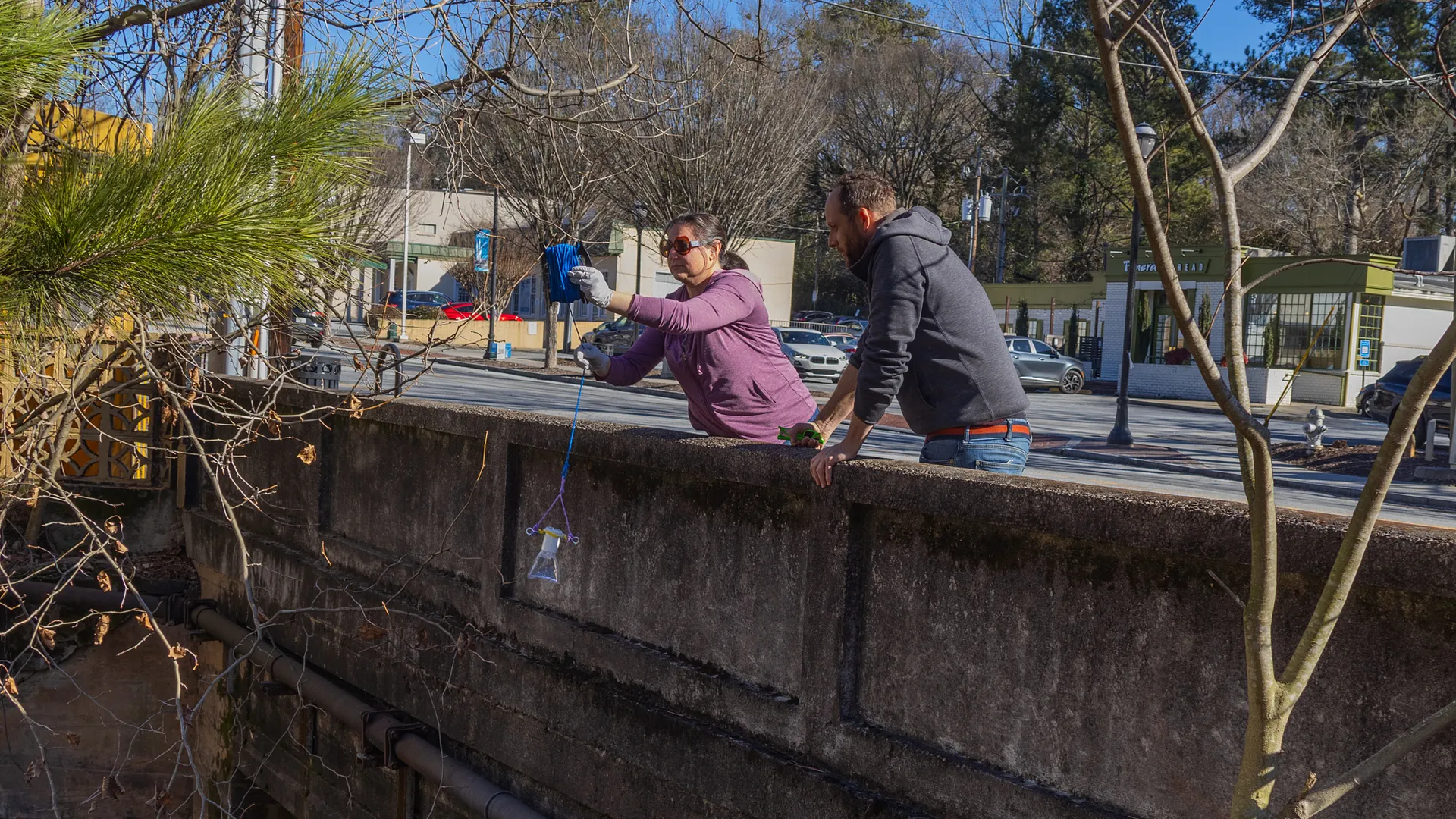
Two neighborhood residents collect a water sample in Emory Village. Photo by Jennifer Camacho
The sample collection and testing wrapped up in December of last year. Fecal contamination levels fluctuated throughout the year. At times they were extremely high.
“There were times when the creek was really contaminated,” says Moe. “Usually there would be spikes of contamination after rainfall, which can be from animal feces washing into the creek. But some of the spikes were so high that it is likely that there are some sewer lines leaking into the creek.”
Moe and her team have shared these results with South Fork Conservancy every step of the way. They partnered with Chattahoochee Riverkeeper to add their data to Neighborhood Water Watch, a project that monitors water quality in urban streams around Metro Atlanta. Yuke Wang, PhD, assistant research professor of global health and biostatistics, and Haisu Zhang, an environmental health PhD student, built a custom dashboard to make the comprehensive data available to community members.
The group now plans to have a community forum with neighborhood residents to present their findings. They hope to work with DeKalb County and the City of Atlanta to further investigate where the contamination is coming from and take steps to fix the issue.
“If we could isolate it to certain hotspots, that would help a lot,” says Moe. “The problem with sewers is that you can’t see what’s happening, it’s all underground, so it will take some detective work and a bit more sampling. Then, we need to see what the data is telling us and use it for some strategic next steps in decision making.”
South Fork Conservancy has also considered expanding testing to more sites around the community. Kyereh led a project to scout and take samples from additional locations in the area that might give useful water quality data.
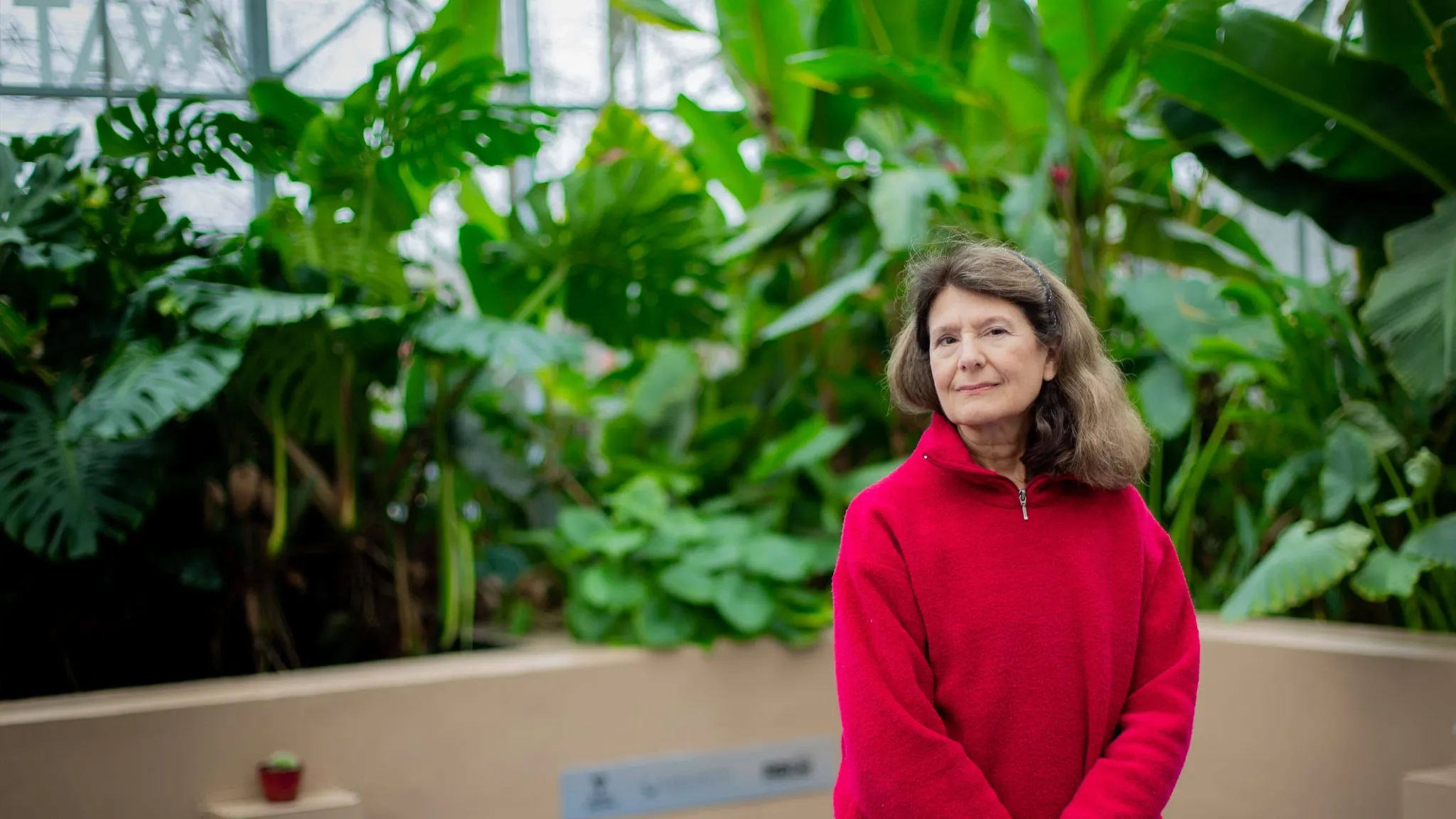
Christine Moe, PhD, lives in the neighborhood near Emory University where the South Fork of Peachtree Creek flows.
When Kyereh got involved in this project during his first year at Rollins, he was interested in safe water and looking to give back to the community around the school. He is now approaching graduation carrying lessons about what community-engaged public health work looks like.
“This work has given me a very good perspective about what contamination we can expect in our waterways. But it has also taught me that projects like this are not just about taking the samples or analyzing the samples,” he says. “You have to dive deeper to see where exactly the problem is coming from, and you have to share it with the community.”
This project, taking place in Emory’s backyard, also serves as a reminder of the responsibility that the university and Rollins have to be good stewards of the environment and be aware of their impact on it.
“It is very important for us at the university to think about our environment and our surroundings. That means not only community relations, but also the environment itself,” says Moe. “These creeks run through our campus, and sometimes they are highly contaminated. We need to understand why. Where does our water come from? Where does our sewage go? Being aware of our local environment and using our scientific expertise to serve our community is an important responsibility.”
This work with South Fork Conservancy is an excellent example of taking that responsibility to heart and letting it inspire action.